

Introduction to Machine Learning: Understanding the Algorithms that Drive Artificial Intelligence

The word “learning” always reminds us of the human ability to acquire new skills or knowledge from experience. However, what if we told you that machines can learn too? This isn’t science fiction—it’s a powerful reality in our modern world known as machine learning, one of the pillars of the Artificial Intelligence revolution.
By understanding how machines learn and evolve, we open doors to innovations that were once unimaginable. This article is an introductory journey through the fundamental concepts and algorithms of machine learning, designed to turn beginners into well-informed AI enthusiasts.
Article contents
What is Machine Learning?
Machine learning is a subfield of artificial intelligence that allows computer systems to learn and improve automatically from experience, without being explicitly programmed. According to Tom Mitchell (1997), “A computer program is said to learn from experience E with respect to some task T and performance measure P, if its performance on T, as measured by P, improves with experience E.”
In practice, this means giving machines the ability to make predictions or decisions based on the analysis of large volumes of data. Real-world examples include product recommendations, medical diagnoses, and virtual assistants.
How Do Machines Learn?
Just as a child learns by observing and interacting with their environment, machines learn through exposure to large volumes of data. With each iteration, they identify patterns, generalize behaviors, and adjust their internal functions to improve performance on a given task.
The quality and diversity of data are essential for the model to learn effectively. Modern techniques like transfer learning have even made it possible for models to be trained with less data by reusing knowledge learned from previous tasks.
Types of Machine Learning
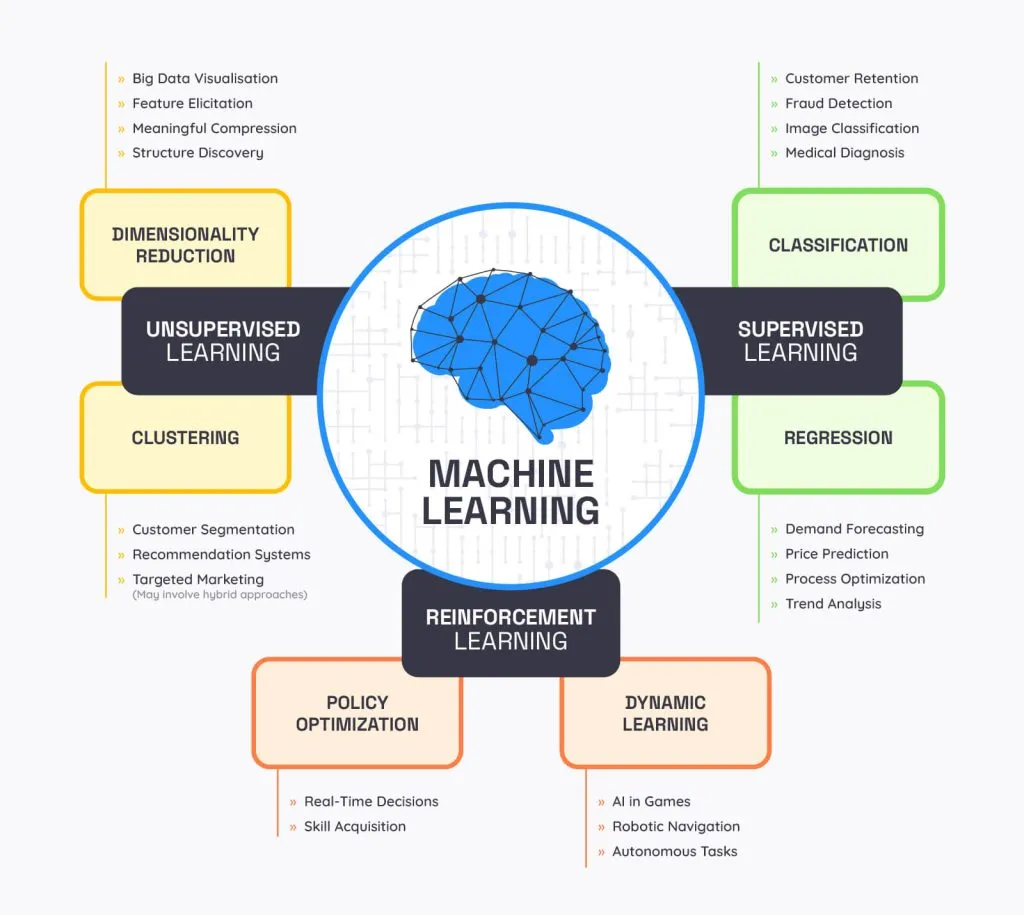
There are three main types of machine learning:
- Supervised: the model learns based on labeled data.
- Unsupervised: the model searches for structure and patterns in unlabeled data.
- Reinforcement: the model learns based on rewards or penalties from interacting with an environment.
Supervised Learning
Supervised learning is the most common type. The model is given a dataset in which each example has an input and an expected output (label). The goal is to learn a function that relates input to output in order to make predictions.
Example tasks:
- Classification: determining whether an email is spam or not, or whether a customer will cancel a service.
- Regression: predicting the price of a house or the demand for a product.
Common algorithms:
- Linear Regression: Finds the best-fitting line for continuous numerical data. Often used to predict prices, grades, or quantities.
- Logistic Regression: Models the probability of a categorical (usually binary) variable using the sigmoid function. Applications include predicting whether a customer will buy or not.
- Decision Tree: Builds a tree of questions and answers leading to a final decision. Useful for both categorical and numerical data. Example: deciding whether to play tennis based on weather, temperature, and humidity.
- K-Nearest Neighbors (KNN): Classifies a new input based on the “K” closest known inputs. Example: classifying a flower based on its measurements.
- Support Vector Machines (SVM): Finds an optimal hyperplane that separates data into two classes, maximizing the margin between them. Common in medical applications, such as distinguishing benign and malignant tumors.
- Artificial Neural Networks (ANNs): Inspired by the human brain structure, they consist of layers of connected neurons. Capable of handling complex classification and regression problems like handwritten digit recognition.
Unsupervised Learning
Here, the data does not have labels. The goal is to identify hidden structures or natural groupings in the data. There’s no specific output associated with each input.
Example tasks:
- Clustering: segmenting customers based on behavior.
- Dimensionality reduction: compressing data while retaining relevant information.
- Outlier detection: identifying atypical or anomalous data points.
Common algorithms:
- K-means: Divides the data into K groups by minimizing the distance between the points and the center of each group (centroid). Used, for example, to segment service users.
- Principal Component Analysis (PCA): Reduces data dimensionality by finding linear combinations of variables that explain most of the variance. Very useful for visualizing complex data.
- Hierarchical Clustering: Builds a hierarchy of clusters (dendrogram), allowing exploration of relationships between data at different levels.

Reinforcement Learning
In this type of learning, an agent interacts with an environment, makes decisions, and receives rewards or penalties based on its actions. The goal is to maximize the cumulative reward in the long run.
Example applications:
- Games like chess or Go.
- Robot or self-driving car control.
- Industrial process optimization.
Common algorithms:
- Q-learning: The agent learns a value function that estimates the future reward of each action in a given state. The optimal policy is derived from these estimates. Example: a robot learning to avoid obstacles in a maze.
- Policy Gradient: Instead of learning the value of each action, it directly learns a policy that maximizes the expected reward. Very useful when actions are continuous or the state space is very large.
- Deep Reinforcement Learning: Combines reinforcement learning with deep neural networks, enabling learning in environments with complex inputs (such as images). Examples include agents trained to play Atari games by only observing the screen.
Conclusion
Although this is just the tip of the iceberg when it comes to machine learning, its impact is already evident in countless real-world applications. Throughout this article, we’ve explored key concepts in the field, its types, and main algorithms.
Machine learning is shaping the future of technology and automated decision-making. We hope this introduction has served as a solid starting point for your journey into the world of artificial intelligence.